

The Tracoe Twist and Twist Plus tracheostomy tubes are used as ventilation and therapy tubes with inner cannulas in hospitals, rehabilitation, and community settings. A special feature is the curved neck flange that moves in both the vertical and horizontal axes, following the movements of the patient’s head. Sizing of the product line always corresponds to the inner diameter of the inner cannula. For example, when it says 08 on the neck flange, the lumen of the inner cannula is 8 mm.
The thin tube walls of inner and outer cannulas allow for a good inside – outside diameter ratio.
Tracoe Twist and Twist Plus tracheostomy tubes are made of polyurethane (PU). The low pressure cuff is made of medical grade PVC. All materials are DEHP-free.
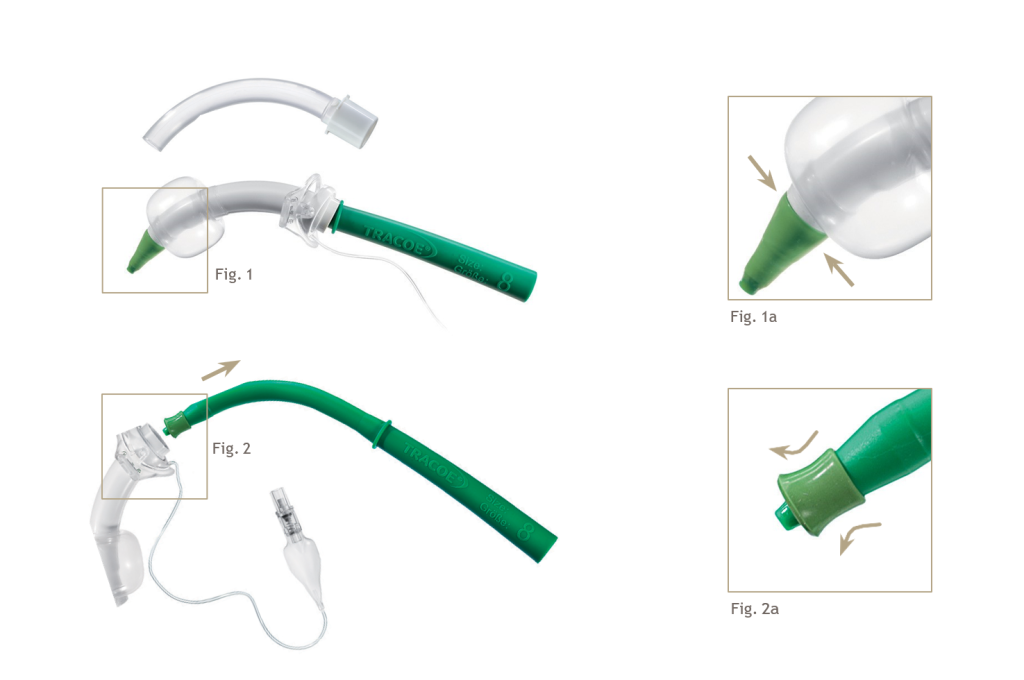
At the tip of the Twist inserter, there is a folding silicone sleeve that bridges the gap in diameter between the inserter and the end of the tube (Fig. 1a). The minimally traumatic inserter is characterized by a fit tailored to the respective tube and a stopper at the proximal end of the tube. This limits the passage through the distal end of the inserter out of the tube. Once the tube is in
the trachea, the inserter is pulled out of the tube. The silicone sleeve flaps back so that the inserter can be removed. (Fig. 2, 2a).
The separately available P-tubes can also be used for reinsertion and/or for tube change, in combination with a Seldinger guide wire, REF 517.
The system for Tracoe Twist Plus consists of two parts: the white guiding catheter with silicone sleeve and the green inserter. The silicone sleeve bridges the gap in diameter between the end of the tube and the inserter (Fig. 1, 1a). The Tracoe Twist Plus tracheostomy tube is supplied pre-mounted on the minimally traumatic insertion system, with the inner cannula already in place. The insertion system is adapted to the specific tube shape and length. Once the tube is in the trachea, the colored inserter, the white guiding catheter with the silicone sleeve, and the Seldinger guide wire are removed together as a single unit. The silicone sleeve
flaps back and the unit can be removed (Fig. 2, 2a). Alternatively, the colored inserter can be pulled out of the tube first, followed by the white guiding catheter and Seldinger guide wire. The white guiding catheter must never be removed first.
The separately available P-tubes can also be used for reinsertion and/or for tube change, in combination with a Seldinger guide wire (REF 518).